Showing posts with label Old Testament. Show all posts

Wednesday, February 2, 2011

An Early Redaction of Isaiah

This quote by Michael Fishbane is absolutely essential in gaining an understanding of the biblical tradition and its interpretation.
Even in the language of the prophets, speaking under divine revelation, we can detect inner biblical exegesis. In Isaiah 29, the prophet is denouncing the people of Judah; they have been the object of his scorn throughout the preceding oracles and no new subject has been introduced. In Isaiah 29:9–11 we would expect to find that it is the people of Judah who are referred to as drunk and who totter and who cannot fathom the prophetic visions given to them. But by the addition of a few words the oracle becomes—by inner biblical exegesis—a rebuke of false prophets. The passage is not easy and requires a close reading; the inner biblical exegesis—the words added by an interpreter—are italicized in the following quotation from Isaiah 29:9–11:
“9. Be astonished and dazed, revel and be, blinded: you have drunk, but not from wine; totter, but not from drink;
10. For YHWHa has poured over you a spirit of stupefaction: He has closed your eyes—namely, the prophets—and your heads he has cloaked—the seers;
11. All prophetic visions shall be sealed from you ….”
Without inclusion of the italicized words it is YHWH who has closed your eyes and cloaked your heads. The object of the denunciation is unspecified. Because of what preceded, however, it would seem that the object was the people of Judah. By the addition of the italicized words—“namely, the prophets” and “the seers”—the object of Isaiah’s scorn has shifted from the people to (false) prophets and seers who do not speak with the true word of God.
Moreover, by the addition of the italicized words, a common biblical literary construction called chiasmus has been disrupted. Here is another clue that we are in the presence of inner biblical exegesis. Chiasmus derives etymologically from the Greek letter chi, which looks like an x; chiasmus refers to a rhetorical construction of an a, b; b’, a’ type. In such a construction, the linguistic features of a second line invert (usually by means of synonyms) those of the preceding one.
In Isaiah 29, without the words added by inner biblical exegesis, we have a perfect chiasmus in which a second line is inversely parallel to a first line, literally:
“He has closed your eyes;
Your heads he has cloaked.”
Here—in the original—it is the people who do not see. In this quotation of Isaiah 29:10, without the inner biblical exegesis, we can identify the preserved original oracle. By the explicatory addition “the (false) prophets” and “the seers,” they—the false prophets and the seers—become the cause of the people’s blindness. The result is that an oracle condemning the people is transformed into a rebuke of false prophets.
Without going into further detail (but relating to this same example), we simply observe that in the Septuagint, an early Greek translation of the Bible, parts of which may date from the third century B.C., this process of exegesis within the text of Isaiah was taken further, for there the abruptness of the intrusion was smoothed over. And a later Greek version, known as the Lucianic recension, went still further in an effort to improve on the Septuagint version without (apparently) ever consulting the Masoretic Hebrew version.
From the viewpoint of the exegetical process, the textual strata represented by the Masoretic text and by the Septuagint and its Lucianic recension reflect continuous rereadings of the original oracle. Moreover, this example represents the most invasive exegetical procedure, which, in the final Hebrew text, transforms the meaning of the passage and disturbs its syntactic balance—a matter later translators into Greek tried to rectify.
Moreover, this striking transformation of an oracle against the people into one against false prophets shows the extent to which the interpretive tradition might introduce a new authority into a received tradition, so that these human comments compete with and ultimately transform the focus of the ancient, divine words. The privileged voice of divine revelation and the human voice of instruction have become one. That this paradox not always perceived is a measure of the scribes’ success in subordinating their voice to that of the tradition. Even more paradoxically, in the end it is their interpretations that have become the received tradition; their oral traditions are the written text given to the community.

Fishbane, Micheal. “The Earliest Biblical Exegesis is in the Bible Itself.” Bible Review, Fall 1986, 42-45.

Saturday, January 29, 2011

What did the Stone Tablets look like?


I am doing some research into the interpretation of the stone tablets which Moses brought down from Sinai, and came across an interesting tangent. Try imagining Moses at and advanced age (or Even Charleton Heston in his prime) walking down a steep mountainside with those two stone whoppers! He then throws them down with enough force to smash them.
We could say that God gave Moses superhuman strength (the text does not indicate such), or we could look for a reasonable interpretation, even if it means relinquishing some of our favourite images.
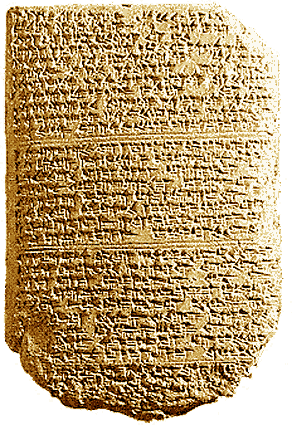
Writing on stone was very common in Egypt of the late Bronze Age. Hundreds of examples have been found. Papyrus was very expensive, so for scrap paper or scribal excersizes, pottery shards and stone flakes were used instead. Here is but one example, recovered at the Valley of the Kings (Deir el-Medina).

Stone flakes of this size could contain around twenty lines of text on both sides, could be easily carried, and easily broken.

Friday, January 28, 2011

Milk and Meat- Why Not?

Thou shalt not boil a kid in its mother's milk.
-Exodus 23:19.

This short injunction forms a major part of the dietary (kashrut) laws in Judaism. Even people who are otherwise lax in their observance of those laws will generally not eat meat and dairy products together (or pork, but we won't go into that).
Regardless of whether or not someone accepts the latter rabbinic interpretations as valid, a significant question still remains. What was the reasoning behind the biblical injunction?
Maimonides, in the 12th, century proposed an ingenious solution, similar to the ones he came up with for other strange prohibitions in the Bible. It was meant to counter idolatrous practices.
As for the prohibition against eating meat in milk, it is in my opinion not improbable that— in addition to this being undoubtedly very gross food and very filling— idolatry had something to do with it.
Perhaps such food was eaten at one of the ceremonies of their cult or one of their festivals
-The Guide to the Perplexed 3:48.

In 1929, archaeological discoveries at Ugarit seemed to prove that Maimonides was right.
Claude Schaeffer discovered a Canaanite religious text which read in part "t\b[h g]d\bh\lb. annh[.]bhm’at". Charles Virolleaud translated the first three words as "Cook a kid in milk."[1]
H. L. Ginsberg picked up the ball and ran with it.
He wrote that the reason the Bible forbade cooking a kid in milk was because it had to do with pagan gods and goddesses. The ritual described in the Ugarit text
“symbolizes the suckling of the newborn gods!”[2]
Unfortunately, Ginsberg and his followers were quite wrong about the connection between the Ugarit text and the biblical injunction.
Basically, the entire reading is wrong. There is no room for an 'h', TBH means to slaughter, not to cook, and GD is coriander.[3]
There have been many other attempts to solve the biblical puzzle, ranging from it being a prohibition on incest, to animal cruelty prevention, to being a mere practicality.
Ethnoarchaeologist Gloria London has an intriguing theory on the reason for the prohibition. In Cyprus, observing how traditional potters work, she was approached by an old woman who told her that “you never put meat into a clay pot with milk.”
London explains that "in times when people used porous clay pots to cook, everyone avoided cooking meat in containers used for milk products."
She goes on to say that "Not only did “others” refrain from mixing meat and milk in antiquity, they do so to this day. From about 300 B.C.E. in the Septuagint (the Greek translation of the Hebrew Bible), the Hebrew word for “milk” was translated to the Greek word galaktos. To this day, traditional Cypriot potters make a goat-milking pot used by women, the galaftiri. It has an open mouth and side spout unlike jars used to process meat products. These pots are never used for meat. Nor are cooking pots ever used for dairy. The shape of the pot says it all—milk or meat. Rather than a dietary restriction limited to a single group of people, it was common practice to keep all ceramic pots used for milk versus meat separate...
Normally in antiquity, as in the Troodos Mountain villages of Cyprus to this day, meat is reserved for special occasions with family and friends. It would be terrible to ruin a fine meal with sour meat as a result of boiling it in a dairy pot. Simple logic kept dairy pots separate from pots used to cook meat. It’s possible that the Bible’s commandment to separate meat and milk boils down to good housekeeping. The straightforward, practical understanding of the Biblical passage originates in the prosaic perspective of a kitchen. It comes from those who make the pots, feed the animals, milk the goat, make the yogurt and cheese, cook the meat, and serve family, friends and community."[4]
The theory, interesting as it is, suffers from some fatal flaws.
First of all, if this was such a commonsensical and practical matter, "good housekeeping", why would it need to be regulated? Why include it in a list of laws governing a covenant relationship? Why the specific mention of kids and mothers instead of milk and meat?
The answer seems to lie in a different direction entirely.
Philo, the Jewish Alexandrian philosopher of the 1st century CE, nailed it on the head.
The reason was to avoid mixing life and death, for it is “grossly improper that the substance which fed the living animal should be used to season or flavor it after its death.”[5]
Jacob Milgrom expands this thought.
This prohibition is, thus, simply another instance of the emphasis on opposites characteristic of biblical ritual and practice: to separate life from death, holy from common, pure from impure, Israel from the nations. The reverence for life and Israel’s separation from the nations are ideas reflected throughout the dietary laws. For example, the reverence for life is reflected in the blood prohibition. Separating Israel from the nations is reflected in the prohibition against eating certain animals such as pig and crustaceans.
Thus the prohibition against cooking a kid in its mother’s milk conforms neatly with Israel’s overall dietary system.
The command not to boil a kid in mother’s milk is first set forth in Exodus, where the context in which it appears shows that it probably applies only to kids sacrificed on one of the Israelites’ pilgrimage festivals. By the time the command appears again in Deuteronomy, however, it is apparent that it has been transformed into something much broader, a new dietary law.
It is easy to see why this prohibition would have been so quickly integrated into the Israelites’ dietary system. It embodies two common biblical themes: reverence for life, even dumb animal life, and Israel’s separation from the nations.
This life-versus-death theory also completely and neatly elucidates the other biblical prohibitions mentioned earlier that, heretofore, have been explained as having humanitarian motives. However, the common denominator of all these prohibitions is that they prevent fusion of life and death. Thus, the life-giving process of the mother bird hatching or feeding her young should not be the occasion of their joint death (Deuteronomy 22:6). The sacrifice of the newborn may be inevitable, but not for the first week while it is constantly at the mother’s breast (Leviticus 22:27); and never should both the mother and its young be slain at the same time (Leviticus 22:28). By the token, the mother’s milk, the life-sustaining food her kid, should never become associated with its death."[6]


[1]Ugaritic Texts, 52:14.

[2]H. L. Ginsberg, The Ugarit Texts, pg. 77.

[3]Milgrom, Jacob, You Shall Not Boil a Kid in Its Mother’s Milk, Bible Review, Summer 1985, pg. 48-55.

[4]London, Gloria, Why Milk and Meat Don't Mix, Biblical Archaeology Review, Nov/Dec 2008, 66-69.

[5]Philo, De Virtute, 143.

[6]Milgrom, BR, Summer 1985, pg. 48-55.

Monday, November 22, 2010

El-Amarna Letters Online


http://www.specialtyinterests.net/eae.html

The El-Amarna Letters come from a diplomatic archive in Egypt, correspondence from Egypt's Canaanite vassals, and are an unparralelled resource for studying the geo-political background to the world of the Bible and ancient Israel. They can be read online now, at the link provided above! Enjoy.

Monday, July 26, 2010

He Gave His Cheek to Him that Smiteth Him

My friend Walker posted on his blog something I had written for an online debate with a notorious evangelical anti-Mormon over the context of certain portions of the Sermon on the Mount.

There are five occurences of smiting the cheek in the Old Testament. Six, if you count a duplicate in Chronicles.

The implications of smiting on the cheek are made clear in the following two scriptures.

"They have gaped upon me with their mouth; they have smitten me upon the cheek reproachfully; they have gathered themselves together against me." - Job 16:10.

"He giveth his cheek to him that smiteth him: he is filled full with reproach." -Lam 3:30.

In these verses, smiting on the cheek is linked to insults. This holds true as well for the following three scriptures:

"And the king of Israel said unto Jehoshaphat, There is yet one man, Micaiah the son of Imlah, by whom we may enquire of the LORD: but I hate him; for he doth not prophesy good concerning me, but evil. And Jehoshaphat said, Let not the king say so. Then the king of Israel called an officer, and said, Hasten hither Micaiah the son of Imlah. And the king of Israel and Jehoshaphat the king of Judah sat each on his throne, having put on their robes, in a void place in the entrance of the gate of Samaria; and all the prophets prophesied before them. And Zedekiah the son of Chenaanah made him horns of iron: and he said, Thus saith the LORD, With these shalt thou push the Syrians, until thou have consumed them. And all the prophets prophesied so, saying, Go up to Ramothgilead, and prosper: for the LORD shall deliver it into the king's hand. And the messenger that was gone to call Micaiah spake unto him, saying, Behold now, the words of the prophets declare good unto the king with one mouth: let thy word, I pray thee, be like the word of one of them, and speak that which is good. And Micaiah said, As the LORD liveth, what the LORD saith unto me, that will I speak. So he came to the king. And the king said unto him, Micaiah, shall we go against Ramothgilead to battle, or shall we forbear? And he answered him, Go, and prosper: for the LORD shall deliver it into the hand of the king. And the king said unto him, How many times shall I adjure thee that thou tell me nothing but that which is true in the name of the LORD? And he said, I saw all Israel scattered upon the hills, as sheep that have not a shepherd: and the LORD said, These have no master: let them return every man to his house in peace.
And the king of Israel said unto Jehoshaphat, Did I not tell thee that he would prophesy no good concerning me, but evil? And he said, Hear thou therefore the word of the LORD: I saw the LORD sitting on his throne, and all the host of heaven standing by him on his right hand and on his left. And the LORD said, Who shall persuade Ahab, that he may go up and fall at Ramothgilead? And one said on this manner, and another said on that manner. And there came forth a spirit, and stood before the LORD, and said, I will persuade him. And the LORD said unto him, Wherewith? And he said, I will go forth, and I will be a lying spirit in the mouth of all his prophets. And he said, Thou shalt persuade him, and prevail also: go forth, and do so. Now therefore, behold, the LORD hath put a lying spirit in the mouth of all these thy prophets, and the LORD hath spoken evil concerning thee. But Zedekiah the son of Chenaanah went near, and smote Micaiah on the cheek, and said, Which way went the Spirit of the LORD from me to speak unto thee? And Micaiah said, Behold, thou shalt see in that day, when thou shalt go into an inner chamber to hide thyself. And the king of Israel said, Take Micaiah, and carry him back unto Amon the governor of the city, and to Joash the king's son; And say, Thus saith the king, Put this fellow in the prison, and feed him with bread of affliction and with water of affliction, until I come in peace. And Micaiah said, If thou return at all in peace, the LORD hath not spoken by me. And he said, Hearken, O people, every one of you." - 1 Kgs 22:8-28.

At the city gates (centre of public life), in front of the leaders of the people, Zedekiah slaps Micaiah on the cheek, humiliating him, this for attempting to deceive the kings.

"Now gather thyself in troops, O daughter of troops: he hath laid siege against us: they shall smite the judge of Israel with a rod upon the cheek." - Micah 5:1 (4:14).

The besieging enemy will smite the ruler with a rod (symbol of authority) upon the cheek, an humiliating gesture of subjugation.

"I will not be afraid of ten thousands of people, that have set themselves against me round about. Arise, O LORD; save me, O my God: for thou hast smitten all mine enemies upon the cheek bone; thou hast broken the teeth of the ungodly." - Psalm 3:6-7 (7-8)

The Psalmist calls upon the Lord to inflict a humiliating and crushing defeat on his enemies.

Now on to material from the rest of the ancient Near East:

In the "Descent of Ishtar into the Netherworld," Ereshkigal of the abode of the dead curses a eunuch (or government official) with a great curse and says:

"The food of the gutters of the city shall be your food;
The sewers of the city shall be your drink;
The shadow of the wall shall be your station;
The threshold shall be your habitation;
the besotted and the thirsty shall smite your cheeks."

The eunuch will live in the gutter, and be humiliated by the lowest of the low- the drunks and bums.

An Akkadian maqlu text preserves the following imprecation:

"I strike your cheek, I tear out your tongue." - G. Meier, "Die assyrische Beschworung Maqlu", 50, 8:101.

As part of the Akitu, or Babylonian New Year ritual, the urgallu, or priest, would do the following on day five:

"After reciting this, he shall remove the table; he shall summon the craftsmen together, he shall deliver the table with all that is on it to the craftsmen, and shall cause them to carry it to Nabu; the craftsmen shall take it, they shall go in the…to the bank of the canal; when Nabu arrives at ….they shall set it up for Nabu; when they have placed the table before Nabu, while Nabu is getting out of the ship Id-da-he-du, they shall offer the loaves of the table; then they shall place on the table water to wash the hands of the king. Then they shall conduct the king into Esagila; the craftsmen shall go out of the gate. When the king has come in before Bel, the urigallu shall come out of the chapel; then he shall receive from the hands of the king, the scepter, the ring, and the harpe, or ceremonial weapon; he shall take his royal crown; he shall bring these things in before Bel, and shall place them on a seat before Bel. He shall come out of the chapel; he shall strike the king's cheek; he shall place…behind him; he shall bring him before Bel; he shall pull his ears; he shall make him kneel on the ground; the king shall repeat the following once:

I have not sinned, lord of the countries; I have not despised thy divinity;
I have not destroyed Babel; I have not caused it to be scattered;
I have not shaken Esagila; I have not forgotten its rituals;
I have not smitten suppliants on the cheek;
I have not humiliated them;
I care for Babel; I have not broken down its walls."

- James Pritchard, "Ancient Near Eastern Texts Relating to the Old Testament", pg. 334.

Around 750 BC, the Aramaeans Mattiel, king of Arpad, and Bargayah, king of KTK entered into a parity treaty. On stela I from Sefire the following curses are recorded, to be heaped upon the violator of said treaty:

40. [Just as] this calf is cut in two, so may Mattiel be cut in two, and may his nobles be cut in two!
[And just as]
41. a [har]lot is stripped naked], so may the wives of Mattiel be stripped naked, and the wives of his offspring, and the wives of [his] no[bles!
42. And just as this wax woman is taken] and one strikes her on the face, so may the [wives of Mattiel] be taken [and…

The laws of eshnunna and the laws of Hammurabi both treat knocking out eyes, teeth, and slaps on the face as severe offences, for which large fines are levied.

A little after Christ’s time, we read in the Mishnah, t. Baba Kama 8:6 that, “If one boxes another man's ear, he has to pay him a sela. Rabbi Yehudah in the name of Rabbi Yosei HaGalili says, [He has to pay him] a maneh [i.e., one hundred dinar;]. If he slapped him he has to pay him two hundred zuz; [if he did it] with the back of his hand, he has to pay him four hundred zuz. If he pulled his ear, plucked his hair, spat so that the spittle reached him, removed his garment from upon him, uncovered the head of a woman in the marketplace, he must pay four hundred zuz.”

The Tosefta Baba Kama 9:31 expands the ruling:

"If one struck someone with the back of his hand… he must pay four hundred zuz, not because it is a painful blow but because it is a humiliating blow."

Smiting the cheek was part of the humliations Christ was subjected to after his arrest.

“And the men that held Jesus mocked him, and smote him. And when they had blindfolded him, they struck him on the face, and asked him, saying, Prophesy, who is it that smote thee? And many other things blasphemously spake they against him.” - Luke 22:63-65.

Nahum Sarna, in his article "Legal Terminology in Psalm 3:8," relates an account from the life of Abraham Shapira:

“In modern times, Abraham Shapira (1870-1965), head watchman of Petah Tikvah and a keen student of the ways and customs of the Bedouin, once observed the trial of two members of a tribe. One had been accused of stabbing someone with a sword, the other of having smacked someone on the face. The presiding sheikh dealt leniently with the stabber but severely with the other one. In explaining his verdict, he stated: ‘The striking of the cheek is a graver offence than stabbing with a sword, for the latter enhances the dignity of a man, while striking him on the cheek humiliates him.’"

Earlier in the same study, Sarna comments that “the various contexts make it absolutely clear , beyond the peradventure of a doubt, that to be struck on the cheek was an intolerable insult, a deep humiliation, not a mere slight to be soon forgotten.”

From personal experience growing up in Israel, I remember that fights, both among Jewish kids and Arab ones, did not get truly nasty until someone spat on another, or slapped him on the face. If that happened, knifings or severe beatings would immediately follow. Things could be patched up at any moment BEFORE such insults. After them, impossible without third-party intervention and serious peace-making efforts.

Back to the Sermon on the Mount, we saw that eye, tooth and smote cheek are mentioned together. The context could not be any clearer: Christ talked of not returning the ultimate personal insults. Nowhere does he say that man must not defend himself, family and friends. Nowhere does he say that if one does not follow that one is not a Christian.