Rob Bowman wrote a blogpost critiquing an installment of Daniel Petersen's column in the Deseret News.[1]
My previous post details why one of Bowman's assumptions is untenable, mainly, the position that the word midrash generally means a specific Tannaitic body of literature. I've shown that there is no reason for that to be considered the default definition. He used that assumption in an attempt to show that Petersen misrepresented his source.
In this post I'll examine another statement of his on which much of Bowman's argument hangs.
Before doing so it is worth explaining my use of the word "mysticism." I use it here in a general sense, the imperfect equivalent of the Hebrew term "
torat ha-sod," similar to how Gershom Scholem used it in his book "Major Trends in Jewish Mysticism." I will be using it interchangeably with "esotericism."
We need look no further than Patai’s book, from which all of the Mormons derive the quotation, to discover that the text dates from at least six centuries later than Aqiva. In Patai’s “Chronological List of Sources” at the back of the book, the “Midrash Alpha Beta di R. Akiba” is listed as originating from the “8th-9th” centuries. In another book, Patai explains the religious context of the work:
“The foundations of medieval Kabbalism were laid in Babylonia and Byzantium in the 7th and 8th centuries, when a number of Midrashim with marked Kabbalistic tendencies made their appearance. Several of these (e.g,, the Alpha Beta of Rabbi Akiba and the Midrash Konen) deal with the mysteries of Creation and the structure of the universe.”
That’s right, the quotation comes from a foundational work in the development of the medieval mystical Jewish tradition known as Kabbalah. This isn’t just Patai’s opinion. It is the scholarly, academic consensus.
Rob Bowman goes on to say that,
The fact that Peterson and several other Mormon apologists resort to utilizing such a quotation while failing to describe its source accurately is especially troubling. This is the only quotation in Peterson’s article that he does not identify specifically. Clearly, had he done so, it would have weakened his argument. Each of the Mormon apologists cited here had the wherewithal to track down the source of the quotation and to state accurately the period of history and religious perspective from which it originated. I make no judgment as to why they all failed to do so.
Unfortunately, beyond stating a range of dates for the composition of the Ottiyot de-Rabbi Akiva (ORA), Rob Bowman has not accurately stated the religious perspective from which it originated. A glaring example is that none of the other references provided by Bowman state that the ORA is markedly Kabbalistic.
Aside from inaccurately describing the religious perspective and not discussing what kind of text the ORA is, Bowman has failed to address important issues affecting the dating of the concepts presented in the work. He has not discussed a single primary source beyond providing the full quote as it appears in "The Messiah Texts", nor said which part he considers late.
Looking at the quote from Patai's "The Hebrew Goddess," I am at a loss to find exactly which tendencies in the ORA Patai saw as markedly Kabbalistic.
Try as I might, I just can't find any. There is no mention of such key Kabbalistic concepts as
Ein-Sof or
Ayin, no emanations (
Sefirot) of the Godhead and their role in the universe, no feminine aspect of God which must be reunited with God, nothing which is specific to the Kabbalah.
If Bowman would assert that there is something explicit or implicit in the text which could be considered specifically Kabbalistic then he must make a case for it.
Kabbalah is often used to refer to all forms of Jewish mysticism, but this usage is sloppy. Though the Kabbalah shares strong affinities with earlier mystical trends, such as the Merkabah mystics or the German Pietists (Hasidei Ashkenaz), as a distinctive movement it mainly stems from 12th century Provence.
Rob's "Proto-Kabbalistic" is not a very useful term generally. I don't know of a single Jewish esoteric text or tradition which couldn't with some justification be called proto-Kabbalistic. It is possible to write many entries on this alone, but a few examples should suffice.[2]
My highschool was not far from Or Haganuz, a Jewish community formed on Kabbalistic ethics and ideals as formulated by a disciple of R. Yehudah Leib Ashlag. Ashlag was a pivotal 20th century Kabbalist who translated the Zohar into Modern Hebrew and attempted to popularise its teachings. His goal was to create an altruistic community based on living the Torah (or rather, the true meaning as revealed by Kabbalah) for Torah's sake. By accepting the life of "thou shalt love thy neighbour as thyself" they would be fulfilling the purpose of creation and would ascend as it were on a ladder to God and cleave to him completely.[3]
Or Haganuz takes its name from a Jewish tradition regarding the light of creation, and literally means the hidden, or concealed light.
Howard Schwartz provides a brief explanation.
Everyone is familiar with the words of Genesis 1:3, And God said, “Let there be light,” and there was light. But the ancient rabbis, who scrutinized the words of the Bible for every hidden mystery, wondered what light this was. After all, God did not create the sun, the moon, and the stars till the fourth day. So what was the light of the first day?...
The rabbis conclude that the two lights—that of the first day and that of the fourth—are different. The light of the first day is a primordial light, what is called the or ha-ganuz, or hidden light. This resolves the problem. But it also raises a whole series of new questions—What was the nature of that sacred light? Where did it come from, and where did it go? These questions have been debated among the rabbis for many centuries, and they arrive at a variety of explanations.[4]
The concept of this light is important to many, if not most, kabbalistic systems, and in its hasidic form exemplifies the philosophy of Or Haganuz's settlers.
This is seen in the teachings of the Rav Kook, who was a seminal figure in modern Judaism and Israeli history. He served as chief rabbi in British Mandate Palestine and did much to bring the gap between the secular Zionist movement and the reactionary orthodox community. For him they both had that part of the truth which the other lacked. The middle path, combining the zealous activism of the former with the deep religiosity of the latter, would help bring salvation to the world.
When I lived in London I used to visit the National Gallery, and my favourite pictures were those of Rembrandt. I really think that Rembrandt was a Tzadik. Do you know that when I first saw Rembrandt's works, they reminded me of the legend about the creation of light? We are told that when God created light, it was so strong and pellucid, that one could see from one and of the world to the other, but God was afraid that the wicked might abuse it. What did He do? He reserved that light for the righteous when the Messiah should come. But now and then there are great men who are blessed and privilaged to see it. I think that Rembrandt was one of them, and the light in his pictures is the very light that was originally created by God Almighty[5]
This light is what sustains and rejuvenates the world, and is expressly manifest through ethical behaviour.
The enlightenment of holy men is the basis for the spiritual illumination that arises in the world, in all human hearts. The holy men, those of pure thought and contemplation, join themselves, in their inner sensibilities, with the spiritual that pervades all. Everything that is revealed to them is an emergence of light, a disclosure of the divine, which adds life and firmness, abiding life and spiritual firmness, which gives stability to the whole world with the diffusion of its beneficience.
A life-giving illumination flows always from the source of the Torah, which brings to the world light from the highest realm of the divine. It embraces the values of the spiritual and the material, the temporal and the eternal, the moral and the practical, the individual and the social. These spell life to all who come in contact with them, and guard them in their purity.
Meditation on the inner life and moral conformity must always go together with those qualified for this. They absorb the light pervading the world, which abides in all souls, and they present it as one whole. Through the influences radiating from their life and their fellowship with others, through the impact of their will and the greatness of their spirirtual being, through their humility and love for all creatures, they then disseminate the treasure of life and of good to all.
These men of upright heart are channels through which light and life reach to all creatures. They are vessels for radiating the light of eternal life. They are the servants of God, who heed His word, the messengers who do His will to revive those near death, to strengthen the weak, to awaken those who slumber.[6]
The Rav Kook's view here is drawn from a core Hasidic concept- the Tzadik.
This is not the place to discuss Tzadikism in depth, but a few words by way of explanation are necessary.
Tzadik is Hebrew for righteous. In Hasidism though it came to represent a special class of leader, a holy man who is the intermediary between the world of God and the world of man. He is the pipeline which draws the holy downwards and the profane upwards. Since he cleaves whole-heartedly to God, his disciples cleave to him. He can intercede for them and raise them up, transforming everything into holiness.[7]
There is a famous Hasidic tradition from the circle of R. Elimelech of Lizhensk, adapted by Martin Buber for the opening portion of "Or Haganuz," his collection of Hasidic stories.
R. Eleazar said: "The light that the Holy One, blessed be He, created on the first day- Adam could see with it from one end of the world to the next. Since the Holy One, blessed be He, looked at the generation of the Deluge and the generation of the Division and saw that their deeds were wicked, He concealed the light from them. And for whom did he conceal it? For the righteous in the future to come."[8]
Hasidim asked: "Where did he conceal it?"
They were answered: "In the Torah."
They asked: "If so, will the Tsadikim not find some of the light as they study Torah?"
They answered: "They certainly will find some."
They asked: "If so, what will the Tsadikim do when they find some of the concealed light in the Torah?"
They answered: "They will reveal it in the way they live."[9]
Apart from the ethical interpretation, there is another aspect of the hidden light which played an even greater role in Kabbalah.
In that classic of Hasidic hagiography, "In Praise of the Baal Shem Tov," a story is told of how R. Baruch was having his oxen sold in a distant town, but worried that they might have been stolen. He sent R. Yosef Kaminker to the Baal Shem Tob (Besht) who then opened the Zohar and read from it.
"I see that R. Baruch's oxen have not been stolen."
R. Yosef asked the Besht, "Is that really written in the Zohar?"
The Besht replied. "This is what our sages said about the verse 'And God saw that the light was good.' They said that it is good to hide it, since with the light of the six days of Creation, one could see from one end of the world to the other. Where did the Holy One, Blessed be He, hide it? He hid it in the Torah. And when they said 'for the righteous in the future to come,' this means for the righteous who will come into the world. Whoever attains the light hidden in the Torah can see with it from one end of the world to the other. Do you suppose that I only saw the oxen? I also saw something which happened in the Jewish community of Amsterdam."[10]
We aren't told what the Besht saw in Amsterdam, but this use of the hidden light is also characteristic of R. Isaac Luria (the Ari) in the hagiography which grew around him.
The hidden light was in him, reaching from one end of this world to the next. He was able to illumine and explain the words of R. Shimon bar Yohai. As it is written in Shivhei Ha-Ari, everything the Ari achieved came from the Zohar.[11]
R. Azriel of Gerona, a leading Kabbalist of the generation before the Zohar had the following to say about the hidden light.
This first light is like the light of thought in which a man sees all that he wishes to look at... and this is the light of wisdom which would rest upon the prophets and crown them with its light, and they would see visions by power, visions of whatever could be, from one end of the world to the next. As long as the soul is pure it shows in her its power and increases, shining brighter and brighter. This light is set apart for the righteous, as they posess a clean and pure spirit, and this light is called the light of life.[12]
Other Kabbalists focused on the implications of the hidden light for creation. R. Shimon ibn Lavi was born in Spain but during his childhood his family was forced to move to Morocco due to the Spanish Expulsion. He was active during the early 16th c. and composed "Ketem Paz," a very important commentary on the Zohar. In it he expresses an idea very similar to the slightly later one found in Lurianic Kabbalah- Tzimtzum, or contraction. The "mystery of expansion" where light is emanated and fills the universe, thus bringing everything into existence, is considered exile, since the light leaves God. The light is then retracted and concealed, since it is too powerful for anything to continue existing in its glare.[13]
This concept of a primeval, hidden light appears both in the talmuds and in various midrashim. One of these quotes has already been mentioned in connection with Buber's anthology.
R. Eleazar said: "The light that the Holy One, blessed be He, created on the first day- Adam could see with it from one end of the world to the next.
Fourth Ezra, a work from around the late 1st c. CE, also knows of such a light.
Then You commanded that a ray of light be brought forth from your treasuries, so that your works might then appear.
This goes back as far as the Hellenistic Jewish writer Aristobolus.
The first [day], the one in which the light was born by which all things are seen together.[14]
Should we consider these as proto-Kabbalistic? That designation quickly becomes meaningless. These texts are not proto-Kabbalistic, even though many of the Kabbalists are often closer to those texts in their thoughts on the nature of this light than the Amoraic statements are.
I doubt that Rob Bowman would consider 1 Corinthians 15:29 proto-Mormon just because LDS use it as a prooftext for the doctrine of proxy baptism.[15]
It is also highly doubtful that he would consider Ezekiel 1 proto-Kabbalistic, even though terminology drawn from it forms an important part of Kabbalistic teachings and modes of expression. Shaul Magid explains how Ezekiel's vision played a role in the way certain Hasidic movements perceived God's interaction with the universe.
R. Gershon Henokh suggests that the telos of Ezekiel’s vision was to reveal the place where divine concealment (koah ha-hester) begins to reveal itself, resulting in the realization that divine absence is itself divine.
"At that time it was God’s will to show Ezekiel how God fills the entire creation. Therefore, he showed Ezekiel the first [highest] place where He could be apprehended until the place that was necessary, i.e., the place of His concealment.
That is, until the world of formation [‘olam ha-yezerah].
As it is explained . . . in the world of emanation, holiness and goodness are
dominant.
This is also true in the world of creation. In the world of formation, however, good and evil are balanced. Therefore, it is only in the world of formation that the power of divine concealment begins. God wanted to show Ezekiel that the power of concealment is itself from God."
R. Gershon Henokh utilizes the Lurianic notion that the chariot is housed in the world of formation (yezerah)—the first world where good and evil appear as distinct—as a support for the Maimonidean claim that the chariot represents metaphysics.
That is, metaphysics is the highest realm of speculation of the divine because it is the first place where God is hidden. Divine absence becomes the first stage of our apprehension of God. The first human apprehension of God is His absence.
For R. Gershon Henokh, the purpose of the vision is for Ezekiel to see and communicate that God’s absence (evil) is the result of divine will.
The Lurianic interpretation of the chariot of Ezekiel lowers the status of the prophetic vision to a place that is accessible to the human intellect and experience, that is, the angelic world where good and evil are already distinct.[16]
There is a Zohar section discussing the elements of Ezekiel's vision.
From these two sparkling spirits the wheels (Ofannim) are created, and they are holy, their nature being like that of the creatures... "It flashed up and down among the creatures" (Ezekiel 1:13). What does "it" refer to? This is the holy spirit... When spirit was composed within spirit, there emerged from them the illumination of one creature, which lies above the four wheels.[17]
Another example that has a little more bearing on the ORA is gematria. Like everyone else in Israel of the days of a single TV station, I grew up watching the comedy program "Zehu Zeh." Every Friday during the Gulf War, it hardly seems an exaggeration to say that it kept the country sane. One of the best-loved characters was the Baba Bubah, a parody of a senile old Moroccan Kabbalist who interpreted contemporary events by exaggerated and implausible use of gematria.
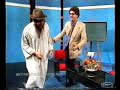
There are and were several radio shows featuring experts in gematria who use it to resolve issues in the callers' lives, and even many internet sites with gematria calculators. In the popular imagination, Kabbalah and gematria are practically synonymous.
The Sabbateans used gematria heavily in their attempts to prove that Sabbetai Tzvi was the Messiah. A generation earlier in what was then part of the Polish Commonwealth, R. Shimshon of Ostropol devoted his life to nullifying the power of the demonic agents of evil-
kelipot, that is, shells. For him these
kelipot were manifested in Christianity. There are numerous instances of fierce anti-Christian mystical polemic in his writings. He used gematria to show that King David provided a key to nullifying the power of Christ. If the numerical values for two of the names of Christ in R. Shimshon's teachings are combined- beam (
korah) and hunger (
raav, consisting of the same letters as raven, which is the antithesis of the dove)- they result in
sar pah (Prince Snare). Psalm 124:7 reads,
Our soul is escaped as a bird out of the snare of the fowlers; the snare is broken, and we are escaped.[18]
Gematria has very ancient roots, and was used in the talmuds as well.
Satan has no permission to act as accuser on the Day of Atonement. Whence [is that derived]? — Rama b. Hama said: "The numerical value of Ha-Satan in gematria is three hundred and sixty-four, that means: on three hundred and sixty-four days he has permission to act as accuser, but on the Day of Atonement he has no permission to act as accuser.[19]
The ORA was important to the developement of the Kabbalah because instead of statements scattered here and there, it presented an extensive treatise on the inner meaning of the letters of the Hebrew alphabet, and, by extension, the possibilities inherent in those letters. There are few concepts in the ORA which can't be found in earlier writings, and this is partiularly true of the quote in question.
Joseph Dan has this to say on what sort of text the ORA is.
This midrash, usually regarded as one collected in the seventh century, is actually an anthology that is distinguished from other similar ones by its keen interest in both cosmogony and mystical literature, but first and foremost by its structure as a commentary on the shape and meaning of the letters of the alphabet. It includes among other things, a brief description of the ascent of Enoch and his transformation to Metatron.[20]
Gershom Scholem, father of the modern study of Jewish mysticism and Joseph Dan's teacher, briefly discussed the ORA as it relates to the textual history of the "Shiur Komah."
Two manuscripts of Shiur Komah versions partially survived on parchment pages in the Cairo Genizah... Further fragments are extant in Hekhaloth Rabbati and Hekhaloth Zutarti... Another fragment is preserved in the so-called Alphabet of Rabbi Akiba, which, to be sure, was edited later than the above-mentioned pieces but nevertheless preserved a great deal of the old Merkavah material.[21]
In other words, according to Scholem and Dan both, the ORA was an anthology of older material. Bowman's emphasis on the late date of the ORA implies that anything in it must be regarded as having a 7th-9th c. provenance. This does not take into account the nature of the ORA. Bowman would need to show that the quote in question is late, since there is sufficient evidence for the continuity from earlier times of the concepts in said quote. Bowman's argument can be illustrated by an admittedly imperfect analogy. If I had written a newspaper editorial on Elizabethan and Jacobean dramaturgy and quoted the following from Charles and Mary Lamb's "Tales from Shakespear" without mentioning the source, would it mean that this scene was from 1806?
Iago knitted his brow, as if he had got fresh light on some terrible matter, and cried: 'Indeed!' This brought into Othello's mind the words which Iago had let fall upon entering the room, and seeing Cassio with Desdemona; and he began to think there was some meaning in all this: for he deemed Iago to be a just man, and full of love and honesty, and 'what in a false knave would be tricks, in him seemed to be the natural workings of an honest mind, big with something too great for utterance: and Othello prayed Iago to speak what he knew, and to give his worst thoughts words. 'And what,' said Iago, 'if some thoughts very vile should have intruded into my breast, as where is the palace into which foul things do not enter?' Then Iago went on to say, what a pity it were, if any trouble should arise to Othello out of his imperfect observations; that it would not be for Othello's peace to know his thoughts; that people's good names were not to be taken away for slight suspicions; and when Othello's curiosity was raised almost to distraction with these hints and scattered words, Iago, as if in earnest care for Othello's peace of mind, besought him to beware of jealousy: with such art did this villain raise suspicions in the unguarded Othello, by the very caution which he pretended to give him against suspicion. 'I know,' said Othello, 'that my wife is fair, loves company and feasting, is free of speech, sings, plays, and dances well: but where virtue is, these qualities are virtuous. I must have proof before I think her dishonest.'
In Hardin Craig's edition of Shakespeare's plays this takes up 91 lines!
Joseph Dan brings up another issue which has bearing on this discussion.
It is sometimes difficult to decide when a text serves as an influential source for further creativity, and when its message is simply reproduced, so that the individuality of both the source and the medieval follower is completely negated.[22]
Rob Bowman hasn't even attempted to show that the ORA quote falls into the former category, he merely asserts that it is.
Lawrence Schiffman discusses Enochian and Hekhalot material in particular, but his observations hold true for Jewish mystical works in general.
The notion of a developing literature of “booklets” that he has explored so carefully regarding 1 Enoch (VanderKam 1984, 17-101) is clearly the correct method with which to understand the eventual emergence of 2 and 3 Enoch as well. These works are composites of documents that were themselves put together from other minor protodocuments, a phenomenon clearly emerging from the results of VanderKam’s detailed research… The close relationship of our official Enoch literature- or better, the various booklets- with other texts (not just traditions) highlights the value of this literary-historical model. Had I sought to work on 2 Enoch and its relation to 1 Enoch, this approach would have been enough to provide a model to understand the development of 2 Enoch… It turns out that “booklets,” or better, short treatises, are the building blocks of all the hekhalot-type texts, as shown by Peter Schafer (1983).
In fact, texts as we know them, independent compositions, are a misnomer for these “texts,” since different manuscripts have different mixes of common, but not always present, building blocks. With this model in mind we can grasp that, like 1 Enoch and 2 Enoch, 3 Enoch is such a composite.
However, 3 Enoch is not just a composite of text traditions such as those found in 1 and 2 Enoch. The circle that produced, exported, composed, redacted, copied, and studied traditions like those in 1 Enoch and 3 Enoch produced various booklets which still circulated in different forms and in different languages after the so-called 1 and 2 Enoch came into being as redacted texts. Some of the original documents circulated in translation. These traditions somehow mixed with those of the hekhalot trend and were redomesticated as part of the emerging textual tradition of late rabbinic/early medieval Jewish esotericism.[23]
Aside from these matters of text, Joseph Dan explains another aspect of Jewish mysticism which Bowman has ignored.
These three subjects- homiletical interpretations of Ezekiel 1, of the first chapters of Genesis, and magic- constitute by far the majority of the parallels found between talmudic and midrashic literature and the esoteric literature. It is true that it is nearly impossible to describe the beginnings of these phenomena, which are so closely integrated with all other aspects of Jewish religious expression from biblical times to the period of the Talmud and Midrash, including the Apocrypha, the Dead Sea scrolls, and early Christian works. One may try to show the beginning of a specific idea or concept in this vast panorama, but the subjects as a whole seem to have been of continuous interest to all trends and tendencies within Jewish culture.[24]
Bowman has asked, or, rather, presented his readers the wrong question.
The kind of questions that should be asked relate to how was the text composed; is it a single composition or is it an anthology; how were traditions transmitted; what in the text is genuinely new or otherwise marks a departure from older texts and traditions; does the designation "medieval" imply a new historical era at this point in Jewish history or is there a continuum in ideas. Bowman declares that the quotation has a medieval theology yet he doesn't show that it is so. His analysis of the quote is just as inadequate.
Continued in the next post...
[1]Rob Bowman's post can be found at http://www.reclaimingthemind.org/blog/2011/08/did-joseph-smith-restore-theosis-part-four-esoteric-jewish-theology-and-joseph-smith%E2%80%99s-doctrine-of-exaltation/ and Daniel Petersen's article at http://www.deseretnews.com/article/700168175/Joseph-Smiths-restoration-of-theosis-was-miracle-not-scandal.html
[2]Other examples include the heavenly Jerusalem, Enoch-Metatron, Shiur Komah, the golem, heavenly ascents, and the Sepher Yetsirah. On the origins of the Kabbalah as a distinct movement see Gershom Scholem, "The Origins of the Kabbalah", Isaiah Tishby "Wisdom of the Zohar" vol. 1, Joseph Dan "Early Kabbalah", and Moshe Idel "Kabbalah: New Perspectives". For an example of a genuinely proto-Kabbalistic text, see Ronit Meroz "The Middle Eastern Origins of Kabbalah."
[3]Boaz Huss, "Altruistic Communism," pp. 125-126.
[4]Howard Schwartz "Tree of Souls," p. Lxxii.
[5]From the "London Jewish Chronicle," September 13, 1935, p. 21. http://asimplejew.blogspot.com/2007/10/rembrandt-rav-kook.html
[6]Abraham Isaac Kook, Ben Zion Bokser (ed.) "Abraham Isaac Kook: The Lights of Penitence, The Moral Principles, Lights of Holiness, Essays, Letters, and Poems," p. 208-209. Bokser's introduction provides an excellent sketch of the Rav Kook and his outlook.
[7]Chapter 3 of Gershom Scholem's "On The Mystical Shape of the Godhead: Basic Concepts in the Kabbalah" discusses the developement of Tsadikism, as does Arthur Green's "Typologies of Leadership and the Hasidic Zaddiq" in "Jewish Spirituality: From the Sixteenth-Century Revival to the Present."
[8]Babylonian Talmud, t. Haggigah 12a.
[9]http://www.schocken.co.il/?CategoryID=165&ArticleID=447 see also Oded Israeli's 2010 lecture http://www.youtube.com/watch?v=MwGOSWLREJM&feature=youtu.be
[10]"Shivhei Ha-Besht" 5:13.
[11]Shaul Magid "Hasidism on the Margin: Reconciliation, Antinomianism, and Messianism" p. 69.
[12]Isaiah Tishby, "Commentarius in Aggadot, auctores R. Azriel Geronensi" p. 111.
[13]Haviva Pedaya "Or Ke-Tavech Ve-Or Ke-Maatefet" http://havivapedaya.com/drupal/node/22 . The existence in North Africa of Kabbalah independent of and predating the Safed center should suffice to illustrate the inaccuracies in the "Hebrew Goddess"'s overview of the Kabbalah. "An important new development took place following the expulsion of the Jews from Spain in 1492, which brought about a powerful upsurge of Messianic longings for redemption, and resulted in the migration of several leading Spanish Kabbalists to the town of Safed in the Galilee. Within a few years thereafter, Safed became the new center of the Kabbala, and held this position for a short but remarkable period in the 16th century. From Safed, the Kabbala spread rapidly to all the Asian, African and European centers of the Jewish diaspora."
[14]4 Ezra 6:40 and Aristobulus, fragment 3. Translation is from James L. Kugel "The Bible as it Was" p. 57.
[15]See J. Trumbower, "Rescue for the Dead: The Posthumous Salvation of Non-Christians in Early Christianity," pp. 55-57.
"I agree with Rissi and Hans Conzelmann (and, for that matter, with Mormon prophet Joseph Smith), that the grammar and logic of the passage point to a practice of vicarious baptism of a living person for the benefit of a dead person." Trumbower's endorsement, however, is far from unqualified. For him, the main difference is one of scale, the ancient texts painting a more limited picture of those eligible for such baptism.
[16]Magid, "Hasidism on the Margin" p. 57.
[17]Isaiah Tishby, "Wisdom of the Zohar" vol. 2, p. 598.
[18]Yehuda Liebes, ""Jonah as the Messiah ben Joseph." For a general overview of gematria, as well as examples of Sabbatean gematria, see Gershom Scholem "Kabbalah" pp. 337-343.
[19]Babylonian Talmud, t. Yoma 20a. The same Parchment and Pen blog has a post discussing Christian gematria. http://www.reclaimingthemind.org/blog/2009/12/walid-shoebat-youtube-video-on-the-mark-of-the-beast/
[20]Joseph Dan, "Jewish Mysticism," 1, p. 156. In a different book, Dan points out the difficulty of deciding what came first in what work. "The schools of the gaonim, the leaders of the great academies in Babylonia, preserved the tradition of Hekhalot mysticism. Rav Hai Gaon, in the beginning of the eleventh century, mentioned in his writings many of the Hekhalot texts. It is difficult to know, whether this intrrest was only literary, or whether there was creative, mystical activity in these schools. The work of editing and preserving many of the Hekhalot texts was undertaken in Babylonia in this period, but how much of the material which has reached us was traditional, and how much was the result of the creativity of these editors we cannot ascertain. Thus, for example, the great anthology of esoteric speculation concerning the alphabet, cosmology, the heavenly realm,the angels and the divine name, known as the Alphabet of Rabbi Akiba or The Letters of Rabbi Akiba, was most probably edited in Gaonic Babylonia. But what parts of this vast collection were ancient, and what were added by the editors, cannot be stated with any certainty. For, the work contains a brief description of the story of Enoch and his rhetamorphosis intoo the Prince of the Countenance, Metatron, along with a list of the secret names of Metaron. The problem is: Did the brief version, included in the Alphabet of Rabbi Akiba, precede the long, detailed version in 3rd Enoch, or vice versa? That is, did some late editor compare the abridged version and add it to an alrteady extant anthology attributed to the ancient sage? There are several philological elements which support each of these possibilites, and a decision either way is impossible at this time."
"Gershom Scholem and the mystical dimension of Jewish history," ch. 3.
[21]Scholem, "Mystical Shape of the Godhead" p. 276-277.
[22]Dan, "Jewish Mysticism," 1, p. 248.
[23]Lawrence H. Schiffman, "3 Enoch and the Enoch Tradition," in Boccaccini (ed.) "Enoch and Qumran Origins: New Light on a Forgotten Connection" p. 160.
[24]Dan, "Jewish Mysticism," 1, pp. 85-86.


